Managed IT Services for Rural Health Care
You have a disaster recovery plan. Do you have an IT longevity plan?
Your IT person has kept the network running for fifteen years. Maybe twenty. Maybe longer.
They know why the radiology VLAN uses that specific IP range. They know which nursing station has the finicky network drop. They know the workarounds, the history, the reasons behind every configuration decision.
They have kept your Critical Access Hospital, Rural Health Clinic, or community hospital functioning through EHR transitions, ransomware scares, and countless after-hours emergencies.
And someday, they are going to retire.
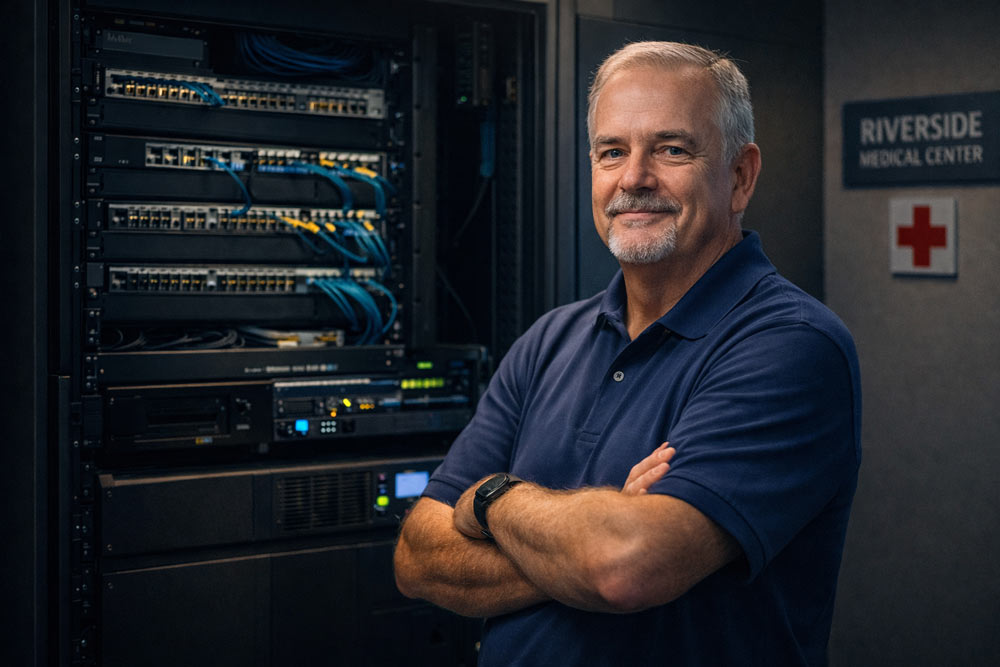
The Question No One Wants to Ask
What happens to your organization when that person leaves?
Not if. When.
This is not a criticism of your IT staff. It is a recognition of reality. Experienced IT professionals are aging out of the workforce. Recruiting replacements to rural communities is genuinely difficult. You already know that pain on the physician side. The knowledge your current person carries often exists nowhere else.
You have a plan for when the server room floods. You have a plan for ransomware. You probably have a plan for extended power outages.
But do you have a plan for when your IT person retires?
A simple test: If your IT person gave notice today, would you feel confident 90 days from now, or would you be hoping nothing breaks while you search for a replacement?
The Scramble Nobody Wants
We have seen what happens when rural health care organizations do not plan for IT transitions.

The longtime IT administrator announces retirement. Leadership scrambles to find a replacement. The job posting sits for months because qualified candidates do not want to relocate to a rural area for what the hospital can afford to pay.
Eventually someone gets hired. Maybe they are qualified. Maybe they are just available.
Either way, they inherit a network they do not understand. Documentation is sparse. The previous person's institutional knowledge walked out the door with them.
The new hire spends their first year just figuring out what exists and why. Meanwhile, compliance requirements do not pause. Security threats do not pause. The EHR vendor does not care that you are in transition.
It does not have to be this way.
If this scenario keeps you up at night, Book a 20-minute IT Longevity Review.
The Impossible Job Description
Here is something most people outside of IT do not fully appreciate: the technology field is not one job. It is dozens of specialties.
Network engineering. Server administration. Database administration. Cybersecurity. Systems management. Software development. Automation. End-user support.
These are not interchangeable skills. The difference between a network engineer, a desktop technician, and a systems administrator is roughly the same as the difference between a cardiologist, a family medicine physician, and a neurosurgeon.
You would never expect your family medicine physician to perform brain surgery. Yet rural health care organizations routinely expect one IT person to handle enterprise networking, server infrastructure, security compliance, database maintenance, and printer troubleshooting, all in the same afternoon.
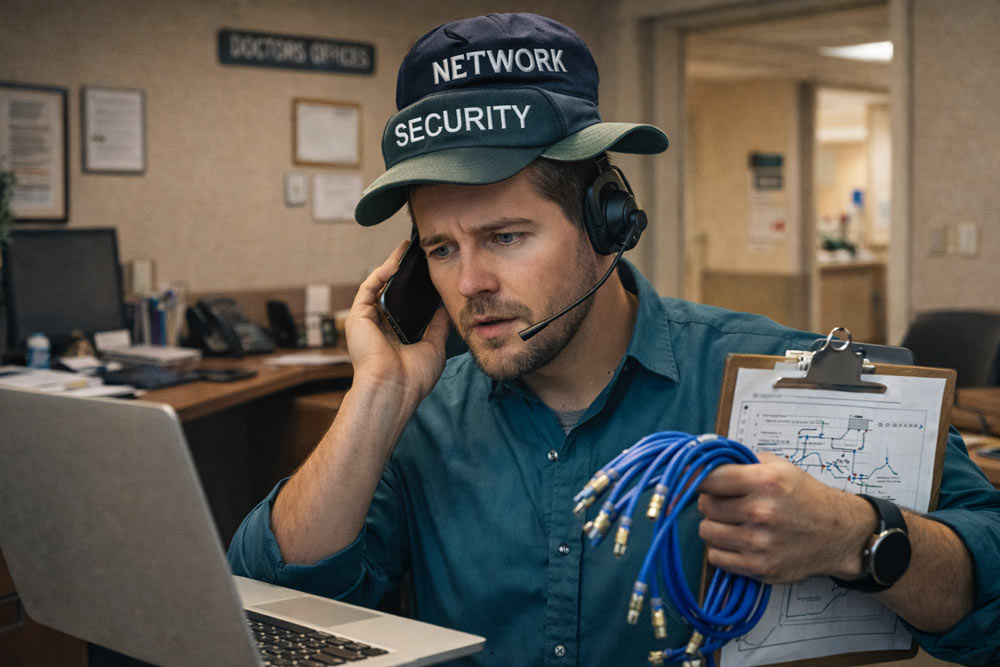
The IT professionals who have successfully done this for years at rural hospitals are remarkable. They have functioned as generalists at an extraordinarily high level, learning enough about each specialty to keep everything running. That is not a criticism. That is genuine respect for an incredibly difficult job done well.
But here is the problem: when that person retires, you are not just replacing one employee. You are trying to find another unicorn.
Someone proficient across all the IT specialties needed to build and maintain an enterprise environment. Someone willing to relocate to a rural community. Someone willing to accept what a Critical Access Hospital can realistically pay. Someone who will also cheerfully handle the daily printer issues and password resets without losing focus on the bigger picture.
That candidate exists. But they are genuinely rare. And hoping to find one before your current person's retirement date is not a strategy.
There is a better approach. Book an IT Longevity Review.
The "We Will Just Hire Someone Fresh Out of College" Fallacy
When the unicorn search stalls, many organizations pivot to a different idea: hire a recent graduate, train them up, and grow your own talent.
It sounds reasonable. Young, eager, affordable. They will learn your systems. They will grow with the organization.
Here is what actually happens.

Most technology graduates want to work in larger, more dynamic environments. That is not a character flaw. It is a rational career decision. Larger organizations offer exposure to bigger projects, clearer advancement paths, and significantly higher compensation.
There is also a financial reality most hiring managers do not think about: these graduates are carrying significant debt. A four-year IT degree can easily cost $70,000 to $120,000 when you factor in tuition, room, board, and books. Even a two-year associate degree runs $30,000 to $50,000 in many cases. These young professionals are not just building careers. They are trying to dig out from under that burden as quickly as possible.
Most rural health care organizations are looking to pay IT staff somewhere around $50,000 to $55,000 per year. That is what the budget allows. But those IT specialties we mentioned earlier? Network engineers, systems administrators, database administrators, cybersecurity professionals? Each of those roles commands $85,000 to $125,000 or more in competitive markets.
A bright young IT hire at your rural hospital will learn quickly. They will discover which specialty interests them most. They will use your environment to build skills and fill out their resume. And when they are ready, they will find an opportunity in a larger market paying twice what your organization can offer, letting them finally get ahead of their student loans.
Can you blame them? You would probably do the same thing.
The result: your rural hospital becomes a training ground, not a destination. You invest in developing someone, they leave, and you start over. Each transition brings wavering direction, incomplete projects, and the accumulation of technical decisions made by people who are no longer around to explain them.
IT turnover at rural health care organizations is not just an inconvenience. It is a compounding problem. Each departure makes the next hire's job harder. Each new person inherits more undocumented history. The environment becomes increasingly difficult to manage, which makes retention even harder.
This is not a people problem. It is a structural problem. And it requires a structural solution.
We built that solution. Book an IT Longevity Review.
Turnover is one of six structural constraints that make rural health care IT different from IT anywhere else. We cover all six, along with current funding programs and implementation guidance, in our rural health IT guide.
IT Longevity Planning: A Different Way to Think About This
Disaster recovery is reactive. Something bad happens, and you recover.
IT longevity planning is proactive. You build systems and partnerships that survive staff transitions, preserve institutional knowledge, and ensure continuity regardless of who is on your payroll.
We hear versions of this constantly from IT professionals at rural health care organizations. They are not looking for an exit. They are looking for peace of mind.
Some are actively delaying retirement because the continuity challenge keeps them up at night. They know what would happen if they left tomorrow, and they cannot bring themselves to do that to an organization they care about. Others are staring at retirement in a few years, wondering what in the world their hospital is going to do when they are finally done working.
They built something. They maintained it. They kept it running when no one else could. That work deserves a proper handoff, not a scramble.
HealthNet: Continuity That Does Not Depend on One Person

visuaFUSION Systems Solutions built HealthNet specifically for rural health care organizations facing this reality.
HealthNet is a shared IT environment where multiple rural organizations pool resources to access enterprise-grade infrastructure, security, and expertise.
But more importantly for this conversation: HealthNet solves the impossible job description.
One organization we support has navigated multiple IT staff transitions. Each new hire stepped into the same standards, the same documentation, and the same upstream visuaFUSION engineering support. No rebuilding from scratch. No "lost tribal knowledge" scramble. Just defined workflows and continuity, regardless of who sits in the chair.
Instead of searching for a single unicorn who can handle every IT specialty, HealthNet lets your organization maintain a capable on-site resource for day-to-day support while accessing a full team of specialists upstream. Network questions go to network engineers. Security concerns go to security professionals. Server issues go to systems administrators.
Your on-site person handles the hands-on work, the face-to-face support, the immediate needs. They are backed by a team with depth across all the specialties that enterprise health care IT demands.
And here is what breaks the turnover cycle: HealthNet provides established processes and workflows for everything a health care organization needs from an IT perspective. When your on-site person leaves, they are not taking "the way things work" with them. The processes remain. The documentation remains. The next person steps into a defined role with clear procedures, not a blank slate they have to figure out alone.
Every HealthNet member receives our IT Standards and Security Policy & Procedures Manual, a comprehensive 125-page operational guide built on HIPAA requirements and reinforced with NIST, PCI DSS, and other industry frameworks. It covers risk analysis, incident response, access control, disaster recovery, workstation security, media disposal, and dozens of other operational areas. It includes ready-to-use templates: visitor logs, security incident logs, risk management tracking, emergency access documentation, and more.
Your organization does not have to build this from scratch. You do not have to figure out what good IT governance looks like for a small health care facility. You sign up, follow the model, and focus on health care.
And you do not have to abandon your existing applications and workflows. We work with member sites to integrate their current software into the HealthNet environment. Unless an application is fundamentally insecure and cannot be remediated, we find a way to make it work. We have been very successful at this. Your staff keeps using the tools they know while gaining the security and infrastructure benefits of a managed enterprise environment.
When your current IT person is ready to retire, they work with HealthNet to ensure a thoughtful handoff. The knowledge they built over decades gets documented, transferred, and preserved. The systems they maintained continue to receive proper support.
And the person you hire to replace them? They do not need to be a unicorn. They need to be a competent, reliable professional who can handle on-site responsibilities. HealthNet provides the specialized expertise that would otherwise require a one-in-a-million hire.
Your retiring IT person leaves with confidence. Your organization continues without disruption. Your next hire walks into a supportable situation instead of an impossible one.
Without a Longevity Plan
- Knowledge lives in one person's head
- Retirement triggers a scramble
- Must find a "unicorn" replacement
- New hire overwhelmed by scope
- Gaps in specialized expertise
- Each transition resets the clock
With HealthNet
- Knowledge is documented and shared
- Retirement becomes a planned handoff
- On-site hire backed by specialist team
- Reasonable job scope for new staff
- Full expertise across all IT disciplines
- Each transition builds on what came before
Ready to see which side of this chart your organization is on? Book an IT Longevity Review.
For IT Professionals Thinking About Retirement

If you are the person who has kept your rural hospital running for years, this page is partly for you.
You have put in the work. You have solved problems no one else could solve. You have stayed late, come in on weekends, and answered calls during family dinners.
You deserve to retire knowing that work will not be undone.
HealthNet lets you be the person who sets your organization up for long-term success. You become the advocate who brings in a sustainable solution. You oversee the transition. You hand off with confidence.
That is a legacy worth leaving.
If you are thinking about your own transition, Book an IT Longevity Review.
For Leadership Thinking About the Future
If you are a CEO, CFO, or board member at a rural health care organization, consider this:
Your IT person is probably not going to tell you they are worried about what happens after they leave. They are too busy keeping things running today.
But if they have been there for fifteen or twenty years, the question is not whether a transition is coming. The question is whether you will be ready for it.
Ask yourself:
If our IT person gave notice tomorrow, how long would it take to find a qualified replacement?
How much of our network documentation exists only in their head?
What would the first year look like for a new hire trying to learn our systems?
Are we planning for this, or just hoping it works out?
Boards plan for CEO succession. They plan for physician recruitment. IT succession deserves the same attention.
We can help you think through this before it becomes urgent. Book an IT Longevity Review.
Why Not Just Hire a Traditional MSP?
Fair question. If continuity is the goal, why not just outsource IT to a managed service provider?
Here is what we consistently see happen in rural health care.

Traditional MSPs build their business model for volume. They serve dozens or hundreds of clients across multiple industries. They standardize aggressively, push preferred vendors, and price services assuming scale that rural hospitals simply do not have.
For a 16-bed Critical Access Hospital, this often means being quoted enterprise pricing for services designed for organizations ten times your size.
Costs creep in quickly. "Out of scope" charges appear. Response times shift when larger clients need attention. Over time, the relationship becomes harder to justify financially.
We hear two versions of this story constantly. Some rural organizations see traditional MSP pricing and immediately know it will not fit their budget. Others sign up, make it work for a year or two, then realize the ongoing cost is not sustainable and have to unwind contracts while rebuilding internal capability they gave up.
If either sounds familiar, you are not alone.
That experience is exactly why we built HealthNet differently.
HealthNet's shared model changes the math. Instead of each organization paying to build and maintain its own full managed environment, participating rural health care organizations share enterprise-grade infrastructure and specialist resources. Costs are distributed. Expertise is available when needed. No one pays for capacity they cannot fully use.
Most organizations are genuinely surprised by the difference.
Curious what it would look like for your facility? Book an IT Longevity Review.
And critically, HealthNet does not replace your local presence. You keep an on-site IT resource for hands-on support and day-to-day needs. HealthNet provides the platform, standards, security, and specialist depth behind them, without the pricing structure that makes traditional MSPs unrealistic for rural health care.
Better Than Affiliation, Too
Some rural hospitals turn to larger health systems for IT support through affiliation agreements.
On paper, it looks attractive. Access to bigger resources. Shared services. Reduced burden.
In practice, affiliation often means giving up control. The larger system makes the technology decisions. They choose the EHR. They set the policies. They prioritize their own facilities when resources get tight.
Your 16-bed Critical Access Hospital becomes a line item on someone else's budget.
HealthNet preserves what matters most: your independence. You share infrastructure and expertise with peers who face the same challenges. You do not answer to a larger system's priorities.
Who This Works For
Critical Access Hospitals where the longtime IT administrator is approaching retirement.
Rural Health Clinics that need continuity beyond what one or two IT staff can guarantee.
Rural Emergency Hospitals navigating new requirements with limited resources.
Organizations that have tried traditional MSPs and found the fit lacking.
Leadership teams thinking proactively about IT succession before it becomes urgent.
Frequently Asked Questions
What is IT longevity planning?
IT longevity planning ensures your organization's technology operations continue smoothly through staff transitions, retirements, and turnover. Unlike disaster recovery (which addresses sudden emergencies), longevity planning addresses the gradual challenge of institutional knowledge walking out the door when experienced staff leave. It includes documented processes, defined workflows, and support structures that survive personnel changes.
How does HealthNet differ from a traditional MSP?
Traditional managed service providers serve many industries and often prioritize larger clients. HealthNet was built exclusively for rural health care organizations. We do not serve banks, law firms, or retail chains. The shared model distributes costs across participating organizations, so you get access to specialized expertise without paying for dedicated resources you cannot fully use. Most importantly, you maintain complete independence - HealthNet is a partnership, not a takeover.
What types of organizations does visuaFUSION serve?
We work exclusively with rural health care organizations, including Critical Access Hospitals, Rural Health Clinics, Rural Emergency Hospitals, and small community hospitals. We do not serve other industries. This focus means we understand the unique challenges of rural health care IT: limited staff, tight budgets, HIPAA compliance requirements, and the difficulty of recruiting specialized talent to rural areas.
What if our IT person is retiring soon?
This is actually the ideal time to have a conversation. Many of our best partnerships begin when a longtime IT professional is thinking about retirement and wants to ensure a smooth transition. The retiring professional often becomes an advocate for the transition because they care about leaving their organization in good hands. We can work together during the transition period to capture institutional knowledge and establish processes before the retirement date.
Do we lose control of our organization with HealthNet?
No. You remain a completely independent organization. This is fundamentally different from health system affiliations, where you may cede operational control to a larger entity. However, HealthNet is a standardized managed platform, not a customizable environment. The value comes from consistency, centralized management, and adherence to defined operational standards built on HIPAA Security requirements. Your on-site IT staff retain appropriate access as needed to perform their roles: local admin access to servers and workstations, permissions to manage user accounts, and other day-to-day responsibilities. We offer tiered access levels depending on your staff's roles, whether they are experienced IT professionals or serving as initial helpdesk support. The difference is that environment-level decisions, security policies, and infrastructure standards are managed centrally by visuaFUSION. For organizations that lack the staff to make complex IT architecture decisions confidently, this is the point: you get enterprise-grade infrastructure managed by specialists while your local team handles the hands-on work they know best.
What does Microsoft Cloud Solution Provider mean?
As a Microsoft CSP Partner, visuaFUSION can provide Microsoft licensing directly to rural health care organizations, often at better pricing than organizations can obtain independently. This includes access to programs like Microsoft's Rural Hospital Program, which offers qualifying facilities significant discounts on enterprise licensing. We handle license management, renewals, and optimization so you do not overpay for licenses you do not need. We even provide license assignment and management automation to help remove IT workload from your staff so they can focus on supporting your organization.
About visuaFUSION Systems Solutions
visuaFUSION is a managed IT and Microsoft licensing provider that works exclusively with rural health care organizations.
As a Microsoft Cloud Solution Provider, we help rural organizations access enterprise licensing programs designed for their situation, including programs specifically for qualifying rural hospitals.
We partnered with Quest Software for backup and disaster recovery. We partnered with Trustifi for AI-driven email security at a fraction of what competitors charge.
Every decision we make filters through one question: does this help rural health care organizations compete on a level playing field?
Let's Talk About Your IT Future
Whether you are an IT professional thinking about retirement or a leader thinking about succession, we would welcome a conversation. No pressure. No hard sell. Just a discussion about what continuity could look like for your organization.
Book an IT Longevity Review20 minutes. Practical. No pressure.
info@visuafusion.com | (308) 708-7490
visuaFUSION Systems Solutions is a Microsoft Cloud Solution Provider, Quest Software Partner, and Trustifi Partner specializing in managed IT services for rural health care. We serve Critical Access Hospitals, Rural Health Clinics, Rural Emergency Hospitals, and small community hospitals across the United States.
Leveling the IT Playing Field for Rural Health Care Organizations.